
Journalist and Syndicate Candidate A Story of Survival
Sells His Library to Stay Alive in a Burning Khartoum - In the middle of a market surrounded by death from all sides

Khartoum Highlight – Amid the ruins of war, the crackle of gunfire, and the stench of death, Journalist Mostafa Mokhtar sits in a quiet corner of the central market in southern Khartoum. He chose a spot near the Sports City—where the first bullet of Sudan’s war was fired—to display what remains of his life: his library.
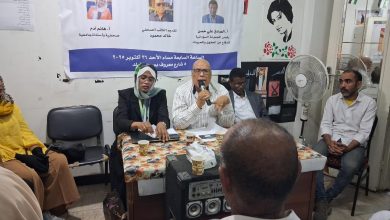
Mostafa was never a trader or street vendor. He had only ever known journalism, a profession to which he dedicated his life. Rising from a junior reporter to the position of editor-in-chief, he was, before the war, a candidate for president of the Sudanese Journalists’ Syndicate . Today, he sits on a worn wooden chair, offering books that few are willing to buy in a time of hunger and death. Once his companions on the journey of journalism, these books have now become his last means of survival.
From Journalism to the Marketplace
Speaking in a faint voice to Khartoum Highlight. Mostafa recalled that from the very first day of the war, he remained with his family in their home in Al-Sahafa district. The walls shook with the sound of gunfire, while death roamed the streets. As displacement spread and jobs disappeared, he began to feel that the profession he loved had turned into an accusation. For a journalist who did not side with either warring party, suspicion came from all directions. Under the tight grip of the Rapid Support Forces (RSF), practicing journalism felt like swimming against the current.
He had no choice but to look for another way to live amid the destruction. After long thought, he decided to sell his books—novels, dictionaries, and works of thought he had collected over two decades. Packing them in a cloth bag, he walked to the market. But on his first attempt, he returned empty-handed. There was no place for books among bread lines and crowded vegetable stalls.
A Corner for Books in the Midst of War
On his second try, a shop owner allowed him to set up a small display in front of his store. He arranged a modest exhibition, using the book titles as banners of life amid the rubble. Some passersby stopped in curiosity, others leafed through the books with nostalgia. For a moment, Mostafa felt he might revive something of the soul of this wounded place.
But it was not only sales he sought. He began renting out books for a small fee to those who could not afford to buy them. His corner soon became a stop for conversations about Tayeb Salih and Adham Sharkawi. And about the schoolbooks lost to students because of the war. Slowly, he felt his improvised trade was bearing fruit, however modestly.
Between Survival and Suspicion
Still, the war would not leave him alone. RSF intelligence repeatedly took him in for questioning, accusing him of working with the army’s intelligence or being an undercover agent. Some mocked him, others called him “Burhan’s relative.” Yet he did not break. He kept displaying his books, and once, a young RSF soldier quietly told him he was a university graduate. Who used to work as a translator before being forced to join the militia. The market itself was constantly under bombardment. Each time the whine of warplanes pierced the air. Vendors would throw themselves to the ground, waiting until the raid passed. Then they would rise to count the bodies and collect what was left of life. Over time, the crowd thinned as many traders decided to leave the city.
Life in the Pages
Mostafa says his book-selling venture was both the most bitter and the most magical experience of his life. It taught him that life never truly ends, and that a man of integrity can find dignity even in the simplest trades—so long as it is honest. Yet he admits the greatest pain he has ever felt was selling his library, not because he abandoned knowledge, but because he needed bread and flour for his children. He often recites the words of poet Awad Jibril, immortalized in a song by singer Mohamed Wardi about hardship, days of distress, and hope. Perhaps he repeats them each morning as he unpacks his bag, arranges his books on the table, and prepares for another day of sales and stories.
In the midst of war, in the midst of ruin, in a market besieged by death, Mostafa chose to be a bookseller. He chose to remain alive.